Why Ningbo and Shaoxing Work So Well Together
Ningbo sits close to the coast on the edge of the East China Sea, and its character comes from water that moves. For centuries it was a trading port, one of the gateways through which tea, porcelain and ideas left China and other things arrived; the old riverside quarter still carries the wide, confident architecture of a city that expected visitors. Shaoxing, less than an hour or so inland by high-speed rail, is the opposite kind of water town. Its canals are narrow, its bridges are humped and pedestrian, and its fame rests less on commerce than on scholarship, calligraphy and the writers who grew up in its lanes.
Practically, the two cities are easy to link. High-speed trains run along the corridor between them, and the ride is short enough to treat as a transfer rather than a travel day. What you should check before booking: which station your train uses, since larger Chinese cities often have several, and the exact departure times, because timetables shift with the season and around public holidays. Use an official booking channel or your hotel to confirm, and allow a buffer for the walk between metro and platform. A sensible split is two nights in Ningbo, one in Shaoxing, with a final morning before you move on.
Days One and Two in Ningbo: Ports, Pavilions and Seafood
Start with the city's maritime story. The riverside old bund area is a pleasant place to walk in the late afternoon, with port-era facades facing the water and a steady local crowd rather than a tourist one. For museums, Tianyi Pavilion is the obvious anchor: a Ming-era private library and garden complex that many describe as among the oldest of its kind in China, with courtyards, ponds and rooms where books were once stored and studied. It rewards slow reading of the labels rather than a quick circuit. If you want an alternative, the city museum is well regarded for its building as much as its collection, and a port or maritime museum suits anyone travelling with children. Verify opening days in advance; several Chinese museums close one weekday and require advance reservation for peak dates.
Ningbo's food is the reason to linger. This is a coastal city that eats what it catches, so expect steamed fish, shellfish, salted and dried seafood, and a strong line in rice-based comfort food: springy rice cakes stir-fried with vegetables, glutinous dumplings in sweet soup, and pickles with real bite. The easiest approach is to eat where the neighbourhood eats: busy, plainly decorated places near markets rather than hotel restaurants. Menus may be Chinese-only, so have a translation app and a few saved phrases ready, and ask what is fresh that day. If shellfish is not for you, say so clearly; broth-based dishes and vegetable plates are usually easy to arrange.
Days Three and Four in Shaoxing: Canals, Bridges and Books
Shaoxing is a walking city, and its pleasures are small-scale. Begin in the old town, where lanes run beside green canals and stone bridges rise in steps steep enough that you will want to take them slowly. Lu Xun, one of modern China's most celebrated writers, grew up here, and the preserved family home and study rooms are worth an hour if you have read even a little of his work. East Lake, formed from old quarry cliffs, offers a different mood entirely, and the Orchid Pavilion site is a pilgrimage for anyone interested in calligraphy. Do not try to see every one of these in a single morning; pick two and let the canal walks fill the gaps between them.
Yellow wine is central to how Shaoxing thinks about itself, and it appears in cooking as often as in cups. You will see jars in shop windows and wine houses that double as small museums explaining fermentation and ageing. Treat these as cultural visits: tastings are typically small, food cooked with the wine is widely served, and non-drinkers lose nothing by ordering the braised dishes and enjoying the aroma. Avoid treating it as a drinking challenge. If you want a quieter counterpoint to the main old town, nearby canal villages offer the same bridges and whitewashed walls with far fewer people, and are easy to reach by local transport that your accommodation can help you arrange.
Dense Landmark Day or Slow Neighbourhood Day?
A dense day makes sense if your time is short or you are travelling with people who like a plan. You front-load the headline sites, start early, keep the bag light, and accept that some stops will be thirty-minute impressions rather than deep visits. The cost is fatigue and a certain sameness: museum, house, temple, dinner. Plan the order around confirmed opening days, group sites by neighbourhood to limit walking, and build in one proper sit-down meal rather than three snack stops. If a site is closed or the queue looks unmanageable, swap it out without regret; there is always something else within a few streets.
A slow day is the better choice after a long flight, with children, or when the weather has turned. Choose one neighbourhood or one museum, do it well, and spend the rest of the day on a teahouse bench, a canal path, or a market. In Shaoxing especially, the pleasure is in the repetition of bridges and doorways, which you only notice when you stop counting sights. A workable compromise for four days is one dense day in Ningbo, one slower day there, then a relaxed pair in Shaoxing where the distances are short and the temptation to over-schedule is lower.
Rain, Respect and Details to Verify Before You Book
Rain changes canal towns more than it changes most cities. Stone lanes and bridge steps become slick, umbrellas crowd narrow passages, and the most photogenic routes are the least sheltered. Rather than cancelling the walk, reorder the day: museums, covered arcades, wine houses and teahouses first, then a shorter waterside stroll in a break. Shoes with grip matter more than an umbrella. Fog and drizzle, on the other hand, make Shaoxing look its best, so if you are comfortable getting a little wet, some of the loveliest hours are the damp ones. Boat services and small attractions may pause in heavy weather, so ask locally on the day.
Many of the places you will visit are not abstractions: shrines are working sites, some old houses still belong to families, and museums guard fragile paper and timber. Ask before photographing people or interiors, keep voices low, dress modestly at shrines, and follow signage about flash and touching even when it seems fussy. Before departure, confirm train times and station names, museum closure days and reservation requirements, whether your chosen sites need timed tickets, and any hotel registration rules for foreign guests. Also check the holiday calendar: Spring Festival and the early-October national holiday transform transport and crowds, and prices move with them, so build your dates around those windows rather than discovering them late.
Planning links and cover photo source
For related planning, read Hangzhou first-time itinerary, Suzhou gardens and water towns, China food travel guide. Check each operator's current visitor notice before paying, because access, reservations, transport and weather procedures can change.
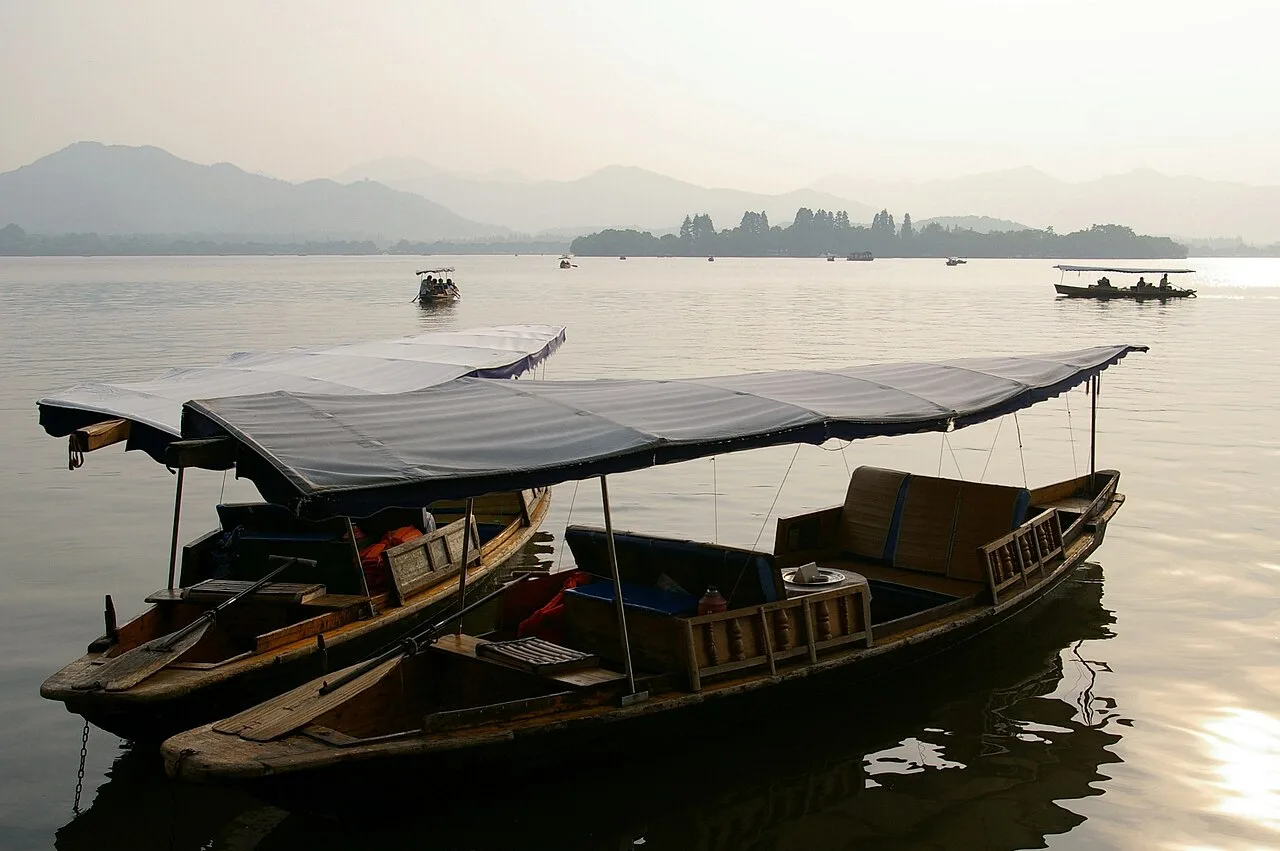
Cover photo: Boats on the West Lake in Hangzhou before sunset by Jakub Hałun, via Wikimedia Commons, licensed under CC BY-SA 3.0. The real photograph was resized and converted to WebP; it is a neutral water-town image, not a photograph of Ningbo or Shaoxing.