Two Nanjings, One Decision
Before anything else, a clarification that saves hours of confusion: the Nanjing in this guide is Nanjing County, written 南靖县, in Fujian's Zhangzhou prefecture. It is not Nanjing, the city in Jiangsu. The tulou area sits in the hills inland from Xiamen, and it rewards travellers who like their architecture at human scale — walls you can touch, courtyards still in use, a village rhythm that continues after the day's visitors leave. It suits people who are content with two or three buildings understood properly rather than ten photographed quickly.
Choose a different trip if you need step-free movement throughout, hotel-style service, or clearly signposted interpretation at every stop. With only one full day, choose a single cluster on a confirmed excursion and accept that the village time will be brief. Travellers carrying heavy luggage should plan around stairs and uneven stone. And if city sightseeing is your main interest, Xiamen and the Fujian coast will give you more per hour. This is a place to slow down rather than collect, and the itinerary below is built on that assumption.
What the World Heritage Listing Does and Doesn't Cover
The UNESCO listing is more specific than the marketing suggests. Fujian Tulou is a serial World Heritage property made up of 46 buildings spread across several locations, inscribed as communal earthen dwellings within a working cultural landscape. That word serial matters: there is no single site containing all 46, and no single ticket that opens every door. Within the same county you will find inscribed buildings, unlisted earthen houses, rebuilt structures and ordinary village homes that happen to be round. Knowing this before you arrive prevents the quiet disappointment of expecting one unified attraction and finding, instead, a lived-in place.
It is also worth resisting two simplifications. Not every resident you meet identifies as Hakka, and not every building you admire is a museum piece with an opening time. Some tulou are private homes where the ground floor is a kitchen and the courtyard is somewhere to dry grain. Others have been adapted, sometimes heavily, for visitors. Carry that distinction with you, and treat the gap between an inscribed monument and somebody's front room as the most useful piece of cultural context you can hold.
Arrival, the Base and the Driver Conversation
Most international travellers reach the area through Xiamen, by air or rail, then continue by road; arriving by train into the county also works well if you confirm your onward pickup before you set out. Rural legs are where plans wobble. A booked car and driver is usually the most practical way to link villages, trading price for flexibility and time. Agree the essentials in writing beforehand: the collection point, expected waiting time at each stop, where the car can park, and the agreed hour of return.
Your base deserves the same scrutiny as your route. Village guesthouses vary enormously. Ask about steps between the road and the door, who carries luggage, sound insulation (timber floors carry every footstep), bathroom arrangements, and heating or cooling for your season. If you need a stay that can register foreign guests, ask directly and get confirmation rather than assuming. A base in or near the Nanjing cluster, around Taxia or a comparable village, keeps the second day's drives short and gives you somewhere quiet to come back to.
Three Days in Nanjing County, Written Out
Day one is a transfer day, and it is better treated as one. Leave Xiamen or your confirmed rail arrival in the morning, allow for a stop, and aim to reach your village base by early afternoon. Settle in, then take a short orientation walk with your host or driver: the lane layout, the nearest communal hall, where dinner will come from. Resist adding a second cluster on arrival day. An early dinner and an unhurried evening are the point — you are adjusting to village time, not to a schedule.
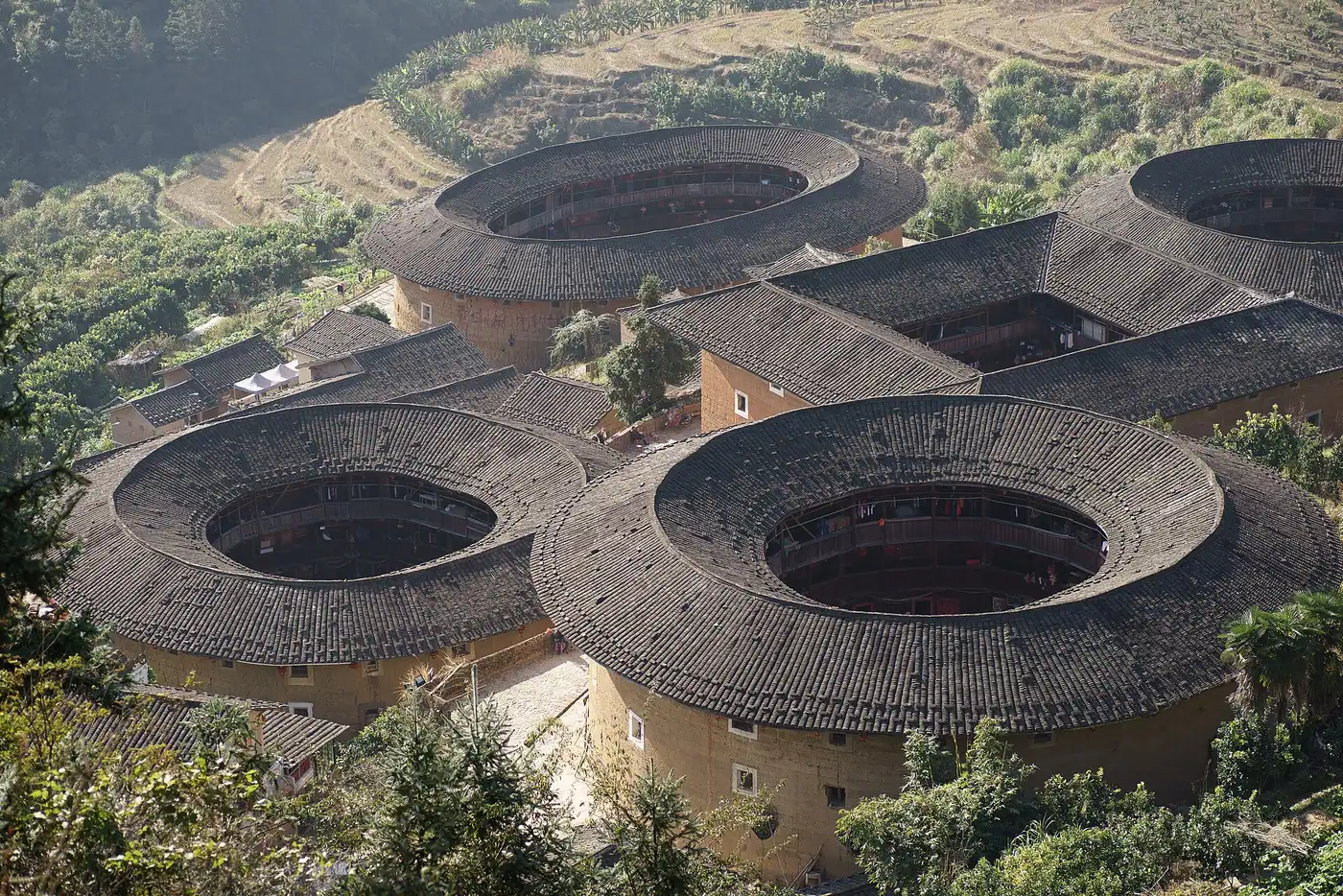
Day two carries the architecture. Tianluokeng, 田螺坑, is the group most photographs promise, and it repays a slow hour. From there, treat Yuchanglou, 裕昌楼, and Taxia, 塔下, as separate stops reached by road rather than a walkable loop; the distances and gradients do not cooperate with that idea. With a driver waiting, a focused visit to these nearby stops can work in one day; walking pace, interpretation, access and road conditions decide how long to spend at each. Decide at the start of the morning which two matter most, and keep some daylight in reserve for the walk back.
Day three belongs to the village rather than the checklist. A quiet morning of tea, courtyard conversation and lanes before anyone arrives is often what people remember. Then leave with a buffer. If a flight or train waits at the other end, build in more time than feels necessary, because hill roads slow in rain and farm traffic keeps its own timetable. If you are tempted to add Yongding on the way out, resist: that is a separate trip with its own base, not a detour.
When It Rains, and the Yongding Alternative
Rain changes this trip more than temperature does. Wet stone paving, wooden stairs and steep lanes turn a fifteen-minute wander into a careful walk, and low cloud can erase the views that justified the drive. The good alternative is smaller, not longer: spend the wet hours on one ground floor, in a courtyard under the eaves, or with a pot of tea at your guesthouse, and let the day contract. Ground-floor rooms are the realistic option for anyone with limited mobility; upper balconies and hillside viewpoints should never be promised in advance, by you or by anyone else.
Yongding is the other sensible first-trip zone, and it rewards the same discipline: pick one base, either around Hongkeng, 洪坑, or around Gaobei, 高北, where Chengqilou, 承启楼, stands. Build the same three-day shape — arrival, a full day of buildings, a slow morning and a timed exit. Do not attempt both counties plus Yunshuiyao in one day; the driving alone will consume it. Choose Yongding if Chengqilou and its village setting are your priority, and Nanjing County if Tianluokeng and Taxia are.
Food, Etiquette and the Mistakes That Cost You Time
Food in these villages is household cooking rather than restaurant service, so ordering is a conversation. Menus may be spoken, chalked on a board, or simply whatever is fresh that day. Order fewer dishes than you would in a city, ask about portion size, and check whether something is spicy, soupy or built around offal before it lands on the table. Confirm breakfast the night before, especially if you plan an early start. Tea is the local opener and the easiest thing to buy directly; ask whether a tasting has a charge or purchase expectation before settling in.
Etiquette here is mostly about asking. Enter courtyards and upper floors only when invited, and take a refusal without negotiating. Many residents have spent years being photographed mid-meal, so assume nothing about portraits, and do not fly a drone over homes without clear permission. Keep your voice low in residential lanes and ask about tasting or demonstration charges. Do not assume English support will be available; arrange interpretation if important, and ask your host which spaces welcome visitors.
The costly mistakes are rarely dramatic. Treating the tulou as one ticketed site leads to wasted drives. Adding both counties and Yunshuiyao to these three days increases road time; it can be arranged, but it changes this slower one-base itinerary. Booking a village stay without asking about steps, luggage or registration can leave you stranded at dusk. Agreeing to a driver without settling waiting, parking and return terms invites disagreement later. And an itinerary with no rain buffer means one downpour dismantles the whole plan. Fix those five things and the rest tends to look after itself.
Background and onward planning
Background references and visitor-information channels: UNESCO: Fujian Tulou. This itinerary was prepared on November 4, 2026. Background pages and government portals are not live opening or ticket notices. Confirm current entry, exhibitions, local transport and weather-related access with the venue and your accommodation for your travel dates.
To extend the route, compare the wider Fujian coast itinerary and Xiamen's three-day plan. For rail booking details, see travelling China by high-speed train; check the exact station name on every ticket before arranging a transfer.
Cover photograph: Tianluokeng Tulou cluster DSC5264 (16013514860).jpg by Motohiro Sunouchi, via Wikimedia Commons, licensed under CC BY 2.0. Resized and converted to WebP.