Why Chengde Deserves Three Days, Not One
Chengde was the Qing court's summer capital, and the scale of the place explains why a flying visit feels thin. The Mountain Resort alone spreads across palace halls, a lake district, open grassland and forested hills, and the outer temples are scattered across the slopes to the north-east. A single day forces you to sprint between highlights. Three days let you treat the resort as a landscape to wander rather than a checklist, and give the temples the quiet time that makes them memorable.
Transfers have become the easy part. High-speed rail from Beijing has turned the trip into a short morning journey, with the fastest services covering the distance in a little over an hour, though slower departures and different stations exist and schedules shift with the season. Long-distance coaches and private cars are alternatives. Whichever you choose, book with your passport details, confirm which Beijing station you are leaving from, and check departure times again a few days out. Rail tickets in China follow real-name rules, so keep the same document with you throughout.
Day One: The Mountain Resort at an Unhurried Pace
Start early at the principal south gate, where the palace section introduces the resort with formal courtyards and exhibition rooms before the landscape opens up. Move slowly here; the transition from ceremonial halls to reed-lined lakes is the whole point of the design. Once you reach the water, follow the paths rather than a route. Bridges, islands and pavilions reward detours, and the early light on the lakes is the best photography of the day.
The afternoons belong to the plain and mountain zones. Internal shuttles and boats are usually available in some form, but they operate seasonally and can be suspended, so treat them as a bonus rather than a plan. If you walk the hill paths, expect genuine elevation and a half-day of steady effort. Carry water and snacks, wear shoes with grip, and accept that you will not see everything. A full day here, finishing with a slow walk back along the lakes, is a better use of time than squeezing in a temple at dusk.
Day Two: The Outer Temples and Their Open Skies
The outer temples sit on rising ground north-east of the resort, built in Tibetan, Mongolian and Han styles to receive visiting leaders and to project an imperial, plural idea of empire. The two most visitors gravitate toward are Puning Temple, known for its immense wooden Guanyin figure, and Putuo Zongcheng, whose tiered red-and-white terraces earned it the nickname Little Potala. Both are large enough to absorb an hour or more, and both involve stairs and sloping approaches.
The important caveat is that the outer temples do not operate as one uniform attraction. Individual sites can close for restoration, open on shorter schedules, or require separate or combined tickets that change from year to year. Do not assume that a temple you saw in a guidebook will be open on your date. Check the current official ticketing channel, or ask at your hotel, the day before, and plan two or three temples rather than five. A realistic day is two sites, a long lunch, and one more if energy allows.
Getting Around: Walking, Shuttles and Sensible Pacing
Chengde's core is compact, and its two great clusters, the resort's southern gates and the temple hillside, are close enough to link by taxi or ride-hailing app in a short hop. There is no metro, and local buses are useful but not always intuitive for a first-time visitor with limited Chinese. Walking works well within the resort and between the nearest temples, less so for the outer edges of the temple district, where the road climbs and the pavements thin out.
Pacing matters more than transport. Summer afternoons can be genuinely hot, and the temple stairs have little shade, so front-load your outdoor hours and keep the middle of the day for the resort's wooded paths or a long rest. Winter is cold enough to shorten every stop, and ice on stone steps is a real hazard. Build in one buffer afternoon across the three days; if a site is closed or the weather turns, that is your room to manoeuvre.
Where to Stay, When to Go, and What to Verify
For convenience, stay near the Mountain Resort's southern gates, where you can walk to the main entrance each morning and reach the temple road quickly. The city centre around the main commercial streets offers more dining variety and a livelier evening, at the cost of a short ride each day. Either way, choose a hotel you can locate easily on a map app before arrival, and confirm that it accepts foreign guests, as registration practices vary.
Late spring and early autumn are the sweet spots: mild days, clear light and comfortable walking. Summer is lush and popular, winter is bracing and quiet. Before departure, verify four things: how tickets are sold and whether you need to reserve in advance, which gates are open, which temples are currently receiving visitors, and whether shuttles or boats inside the resort are running. All of these are administrative details that change, and none of them should be taken from an old blog post, including this one.
Practical Questions Before You Book
Most travelers want to know whether Chengde can be done from Beijing without an overnight. It can, on paper, but the day becomes a transfer exercise with a rushed resort visit. If your schedule allows only one day, choose either the Mountain Resort or two outer temples, not both, and accept that you will leave things unseen.
The other common question is about fitness. The resort's lake zone is gentle and largely flat, while the hill paths and temple staircases demand more. Travelers with limited mobility can still enjoy the palace halls and lakes, and should ask at the entrance about accessible routes and any internal transport running that day. Families with young children do well with the resort's open spaces and shorter temple visits, and should avoid stacking multiple stair-heavy sites into one afternoon.
A Note on Changing Details
Heritage sites in China are living administrative entities, not fixed products. Tickets move online, opening days shift with restoration cycles, gates are reassigned and shuttle services pause for maintenance or weather. Prices, timetables and policies mentioned in any guide should be treated as background rather than fact.
The reliable approach is simple: check the official ticketing channel or a trusted local source shortly before you travel, carry your passport, arrive early, and leave one flexible half-day in your plan. Chengde rewards that patience. Give it three days, expect to walk more than you think, and let the lakes and temple hillsides set the rhythm.
Planning links and cover photo source
For related planning, read Beijing first-time itinerary, China attraction ticket guide, China high-speed train guide. Check each operator's current visitor notice before paying, because access, reservations, transport and weather procedures can change.
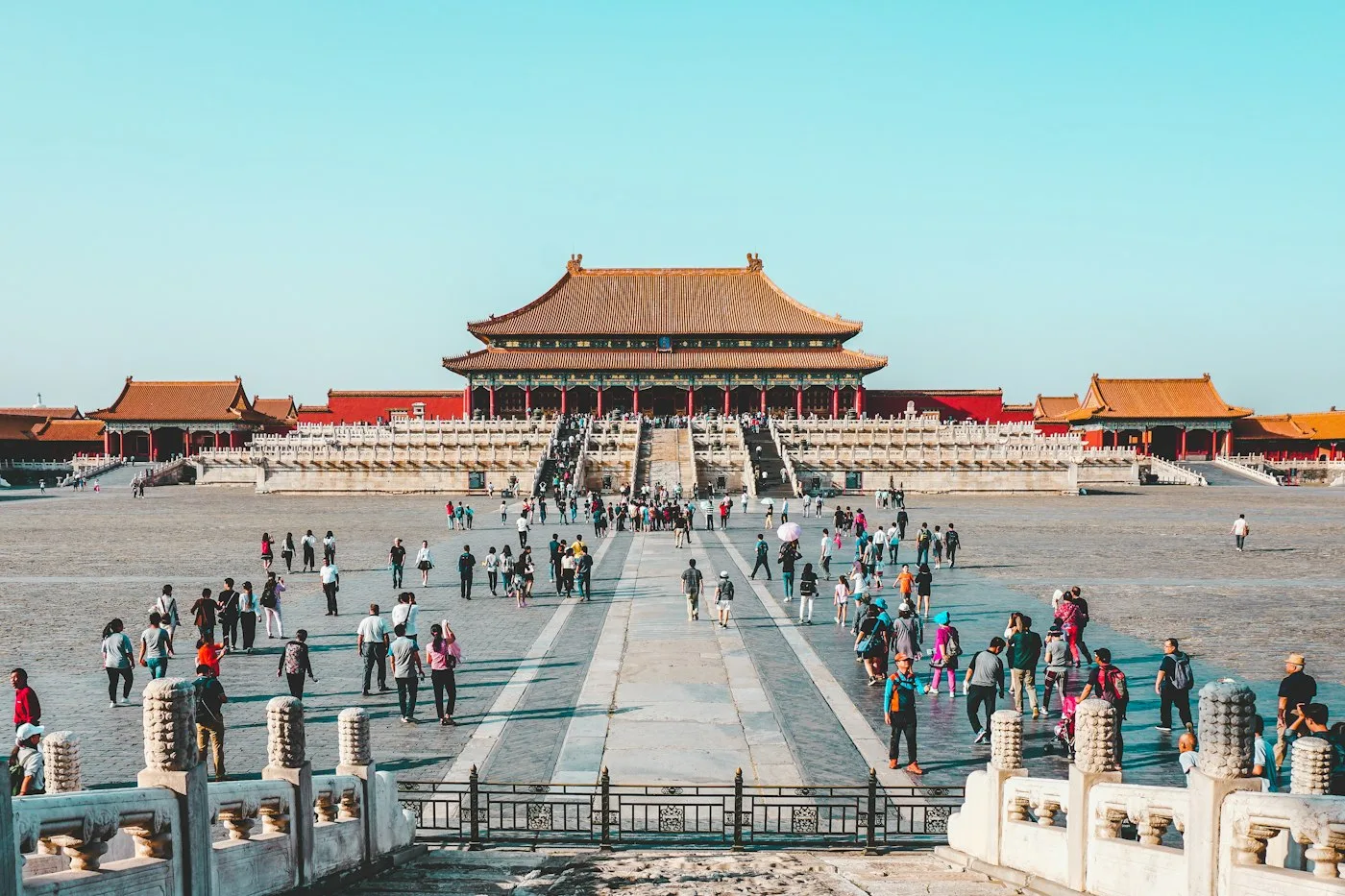
Cover photo: visitors crossing a courtyard in the Forbidden City by Unsplash, used under the Unsplash License. It is a neutral Chinese heritage image, not a photograph of Chengde.