Read the setting instead of memorizing a rulebook
China is not culturally uniform, and etiquette is not a checklist that every person follows in the same way. A busy commercial street, a quiet ancestral hall, a Buddhist monastery, and a contemporary art museum ask for different kinds of attention. Start by observing how visitors and staff use a place. Signs, barriers, announcements, and direct requests take priority over a tip from an old travel forum, especially because site procedures can change.
When you are unsure, choose the option that gives other people space and preserves the place. A soft voice, a clear path through a doorway, and a quick question to staff are usually more useful than trying to guess what a gesture means. You do not need to perform local identity or copy every custom. Showing interest without entitlement is a good starting point, and a sincere 'xiexie' (thank you) is welcome even when your pronunciation is imperfect.
Visit temples and sacred places with care
Temples and religious sites may be active places of worship as well as historic attractions. Keep your voice low near prayer halls, avoid stepping across offerings or interrupting a ceremony, and give worshippers room to move. Follow instructions about shoes, incense, candles, restricted rooms, and photography; practices vary by site, and a custom seen at one temple is not permission to repeat it elsewhere. If a space is closed to visitors, do not enter for a better view or photograph.
Dress in a way that feels respectful for the particular place and weather. There is no single outfit rule for every Chinese temple, but clothing that covers comfortably and does not draw attention away from worship is a considerate choice. Avoid touching statues, ritual objects, calligraphy, or offerings unless staff explicitly invite you to do so. If you would like to take part in a ritual, watch first and ask a guide or attendant how to do it appropriately rather than treating it as a photo opportunity.
At heritage sites, respect ropes, railings, restoration work, and fragile surfaces even when other visitors step around them. Do not climb a wall, sit on a carved feature, or move an object for a cleaner picture. Many major sites require timed reservations or have specific entrances; our China attraction ticket guide explains how to check current entry information before you arrive.
Ask before photographing people
A landscape, building, or crowded public square can be photographed without making every person in it part of your story. If you want a close portrait or a picture centered on one person, make eye contact, gesture toward your camera, and ask first. A simple 'keyi pai zhao ma?' (may I take a photo?) can help, but a translated phrase on your phone works too. If the person hesitates, turns away, or says no, smile, lower the camera, and move on without bargaining.
Be especially careful with children, older people, street vendors, performers, people at prayer, and anyone whose work or circumstances could make them feel unable to refuse. Do not use a long lens to bypass consent, photograph someone through a home window, or keep filming after a person asks you to stop. A public place is not the same as a blanket invitation to publish a close-up. If you plan to use a portrait commercially or in a prominent editorial context, seek clear permission for that use rather than assuming that permission to take the image covers every later use.
Also check signs and staff directions about photography inside museums, memorial halls, exhibitions, and religious buildings. Flash, tripods, selfie sticks, or video may be limited even when a phone photo is allowed. Avoid blocking a narrow passage while composing a shot, and do not photograph security operations or restricted areas. When in doubt, ask a staff member before taking out equipment.
Treat residential streets as lived-in places
Historic lanes, courtyard homes, and old neighborhoods are not open-air sets. A doorway may lead to someone's home even if the lane is popular with visitors. Do not step inside a gate, peer through a window, sit on a resident's doorstep, or photograph family members through an entrance. Keep your voice down in narrow residential streets, especially early in the morning and late at night, and make room for residents carrying groceries, bicycles, or deliveries.
Small businesses and market stalls are different from private homes, but people working there still deserve a choice about being photographed. If you want to take a picture of a craft, a product, or a vendor at work, ask and be prepared to make a purchase only if you genuinely want one. Do not assume a smile means consent to a portrait. If a lane is signed as private, closed, or resident-only, choose another route rather than following a tour group through.
Move patiently through queues and public transit
Queues can form around ticket checks, security screening, lifts, food counters, and platform doors. The shape may look informal, especially in a busy station, but look for a marked line, a numbered ticket, or the point where people are joining. If you cannot tell, ask 'dui wu zai na li?' (where does the line start?) or let someone go ahead while you clarify. Avoid pushing forward because you are worried about missing a train; ask staff for help and leave a generous buffer instead.
On a metro or bus, let people exit before you board, keep bags close, and move away from the doors once inside when space allows. Offer a seat to someone who appears to need one, but do so without making a spectacle of it. Keep calls and videos at a considerate volume, and do not spread luggage across a seat during a crowded ride. The details of priority seating and station procedures can differ, so follow signs and staff announcements. For longer intercity trips, our China high-speed train guide covers station timing and boarding preparation.
Keep everyday interactions simple and warm
A brief greeting, a smile, and a clear request often work better than an elaborate attempt at humor when language is limited. Speak at a normal pace, use short sentences, and show the written destination or item you mean. Translation apps are useful, but give the other person time to read the screen and correct a mistranslation. If communication stalls, patience helps more than speaking louder. Thank staff even when a process is unfamiliar, and ask before touching a product, display, or someone's belongings.
Personal space and conversational style vary from person to person. Some questions about age, family, work, or where you are from may feel direct to a visitor; they are not necessarily a demand for private information. You can answer briefly, change the subject, or decline politely. Similarly, do not assume that one person's behavior represents a whole city or country. Curiosity is welcome when it is mutual, but people are not responsible for giving a cultural explanation whenever a visitor asks.
Enjoy shared meals without turning etiquette into a test
Meals can involve shared dishes, different serving styles, or a host who offers more food than you expected. Follow the table's lead, use serving utensils when they are provided, and ask for a spoon or fork if you need one. A friendly refusal or 'thank you, I am full' is enough when you do not want more. Table manners vary by family, restaurant, and occasion, so there is no need to treat one gesture as a universal cultural rule. Our China food guide has practical advice on ordering and dietary needs; this guide keeps the focus on the wider social setting.
Tipping is not generally expected in ordinary restaurants, though policies differ in some tourist services and upscale settings. Check the stated price or bill, and ask what a charge means if it is unclear. A gracious thank-you, paying the displayed amount, and leaving the table in reasonable order are more reliable signs of respect than importing a service ritual from home.
Respond well when you make a mistake
Visitors will occasionally stand in the wrong place, misunderstand a sign, or miss a local cue. If someone corrects you, pause, acknowledge it, and adjust without turning the moment into a debate. A short apology such as 'dui bu qi' (sorry) can help, but the useful part is changing what you are doing. If a request is unclear, ask staff to explain or point to the relevant sign rather than relying on a bystander's guess.
A thoughtful visit is not about avoiding every awkward moment. It is about noticing the effect you have on others and being willing to adapt. Leave enough time to read signs, follow the route set by a site, and step aside before checking your phone. Plan your days at a humane pace; our China itinerary planner offers route ideas that leave room to experience a place rather than rushing from one photo stop to the next.
Cover photo source
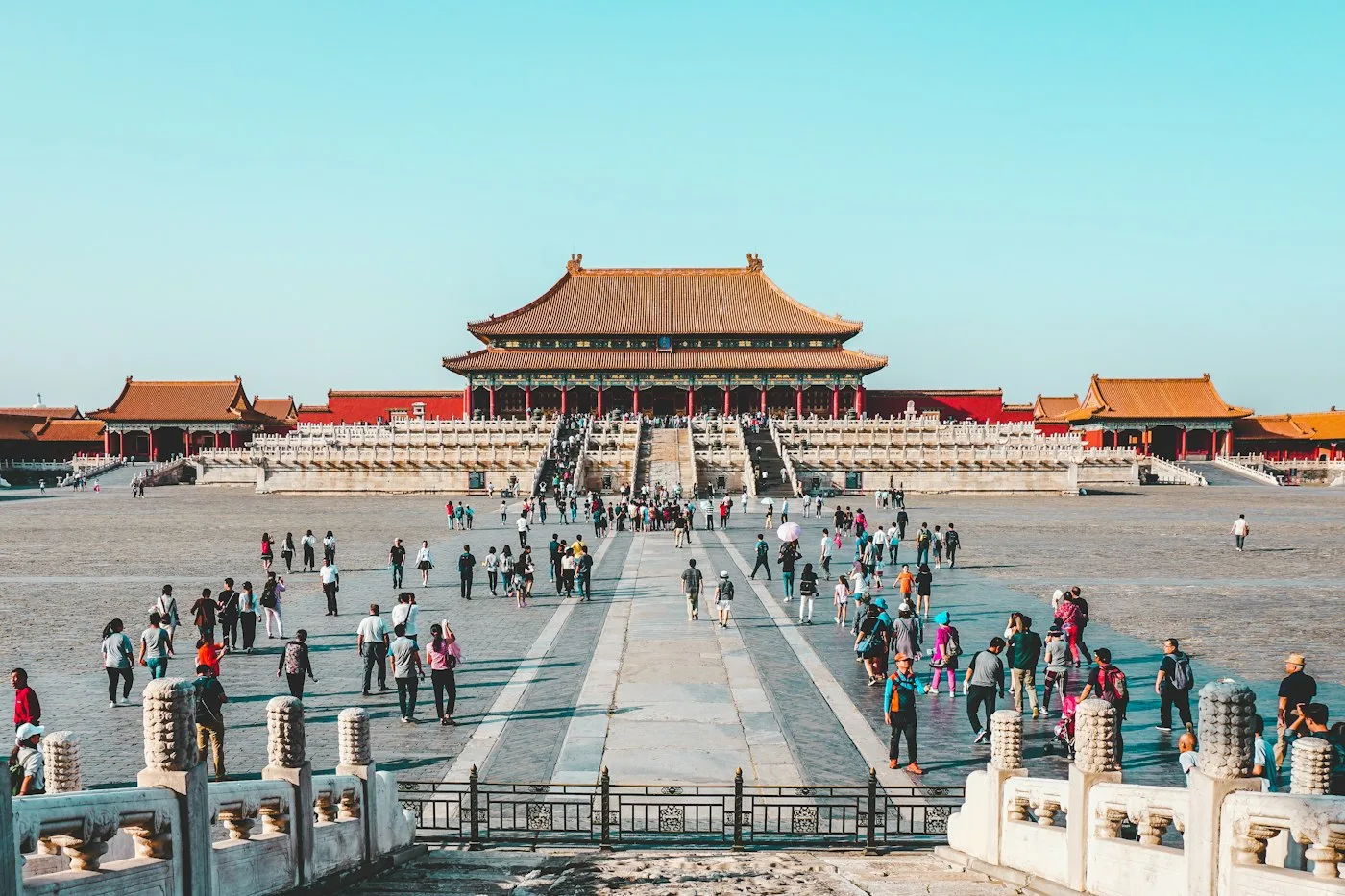
Cover photo: Visitors in a courtyard at the Forbidden City, Beijing. Photo from Unsplash, used under the Unsplash License.